Some wounds do not heal the way one would wish. They weep, become inflamed again and again, or fail to settle over weeks. Such difficult wounds, together with chronic skin infections and hard-to-reach areas, call for a gentle, effective treatment. Cold plasma therapy is a modern procedure that addresses exactly this. This overview explains what cold plasma is, how it works, for which wounds it can be useful and how a treatment at our practice in Cremlingen works.
What cold plasma is
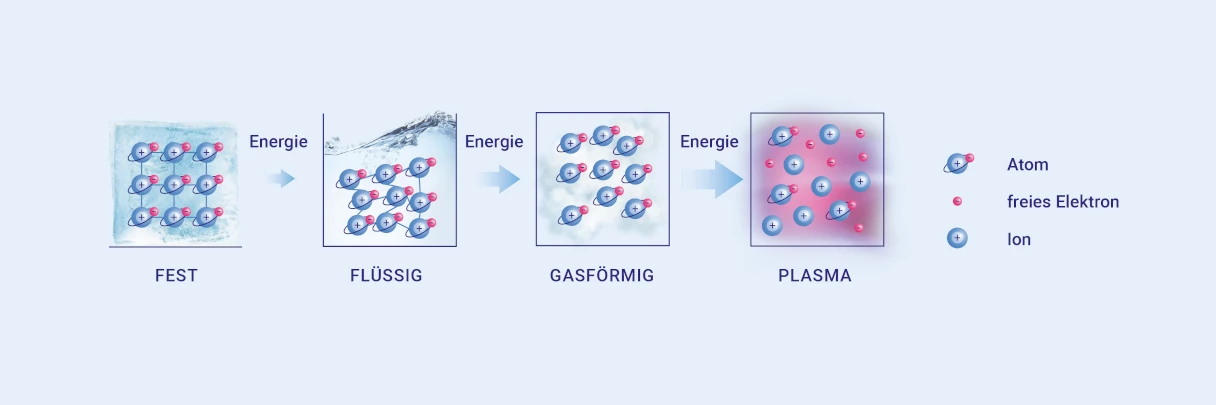
Plasma is often described as the fourth state of matter — alongside solid, liquid and gaseous. It arises when energy is supplied to a gas and it thereby becomes partially ionised: electrically charged particles separate out from the neutral gas particles. In nature we encounter plasma in the form of lightning or auroras, for example.
For medical use, what is known as cold plasma is employed. Unlike hot plasmas, it arises at room temperature and does not feel hot on the skin. In cold plasma, reactive oxygen and nitrogen species form — chemically active particles that are decisive for the effect on the wound. Because the plasma stays cold, it can be directed straight onto sensitive tissue without damaging it through heat. This makes the treatment painless.
How cold plasma therapy works
The effect of cold plasma is based on the reactive oxygen and nitrogen species that form directly on the wound surface. These particles act against bacteria, viruses and fungi: they damage the cell envelope and the genetic material of the pathogens, so that they die off. Pathogens are considerably more sensitive here than the animal's own cells — healthy tissue is not attacked by the short, targeted application.
Beyond reducing germs, cold plasma can support wound healing. The reactive particles stimulate the formation of new cells, promote blood flow to the wound area and support the formation of new blood vessels. A well-perfused wound with an active cell metabolism has better conditions for closing. In this way cold plasma therapy combines two approaches: it reduces the germ load and at the same time creates more favourable conditions for the body's own healing.
Our device: argon jet plasma (kINPen VET)
At our practice we use high-quality argon jet plasma. The kINPen VET from the Greifswald manufacturer neoplas. This CE-certified medical device generates cold atmospheric plasma (CAP) from the inert gas argon and delivers it as a fine, focused plasma jet. This allows the wound surface to be treated precisely and without contact, even in recesses, skin folds and hard-to-reach areas. The temperature at the tissue stays below 40 °C, and the treatment is pain-free.
The "jet" refers to the directed plasma beam: unlike flat-surface methods, argon jet plasma also reaches jagged wound margins and niches in a targeted way. It combines two effects in a single step. It inactivates a broad spectrum of micro-organisms, including multi-resistant pathogens such as MRSA, and at the same time stimulates cell and tissue regeneration.
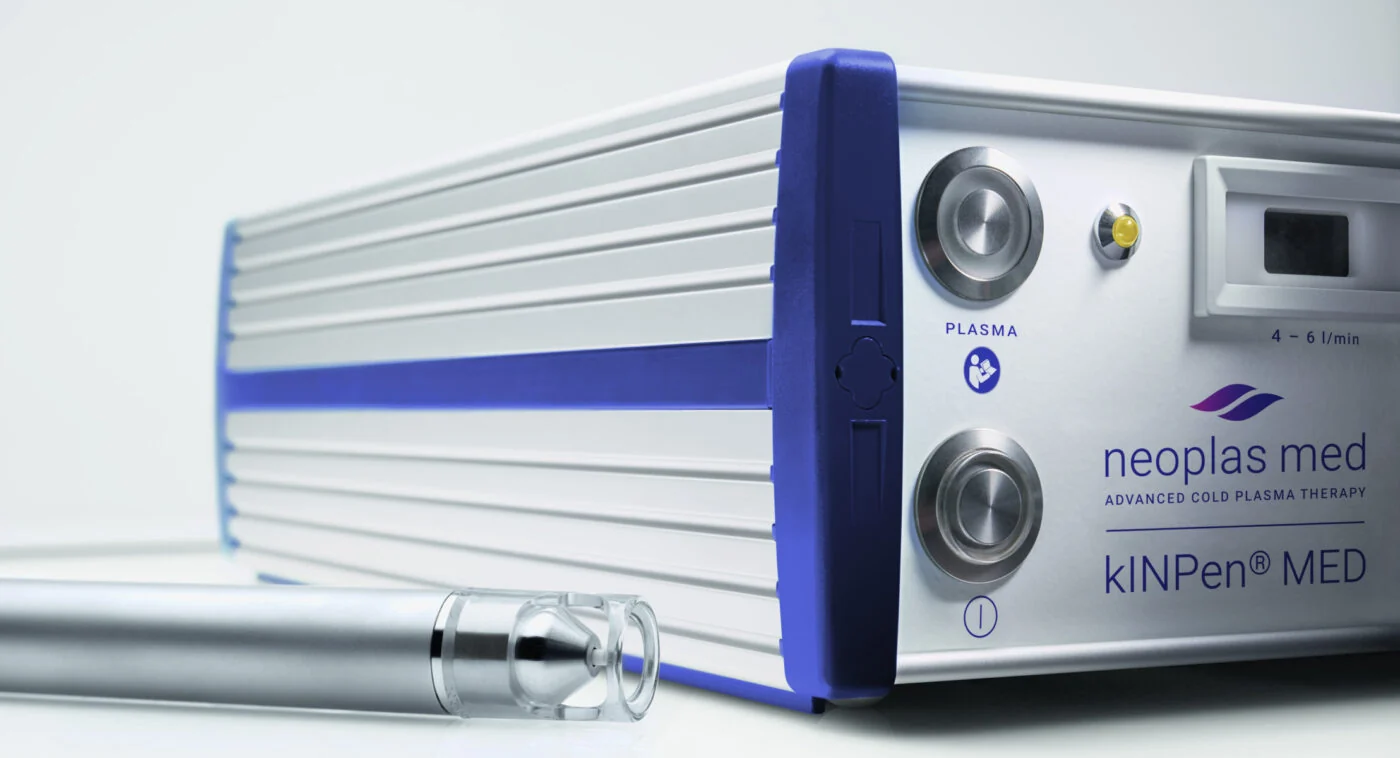
The kINPen cold plasma technology is the result of years of scientific collaboration between neoplas med GmbH and the Leibniz Institute for Plasma Science and Technology (INP), Greifswald University Medicine, the Charité Berlin and further research and industry partners. The human-medical kINPen MED was the world's first CE-certified plasma jet approved as a Class IIa medical device for treating chronic wounds and pathogen-related skin conditions.
From research: A human-medical pilot study at Cologne University Hospital (Werra et al., Journal of Clinical Medicine 2025) examined a single intraoperative application of argon jet plasma on open inguinal incisions in high-risk patients. Result: the rate of revision-requiring wound healing disorders dropped from 32 % in the control group to 8 % in the plasma group, a relative reduction of around 75 %. We discuss how transferable this is to your individual case in veterinary medicine personally with you.
Active components & mode of action
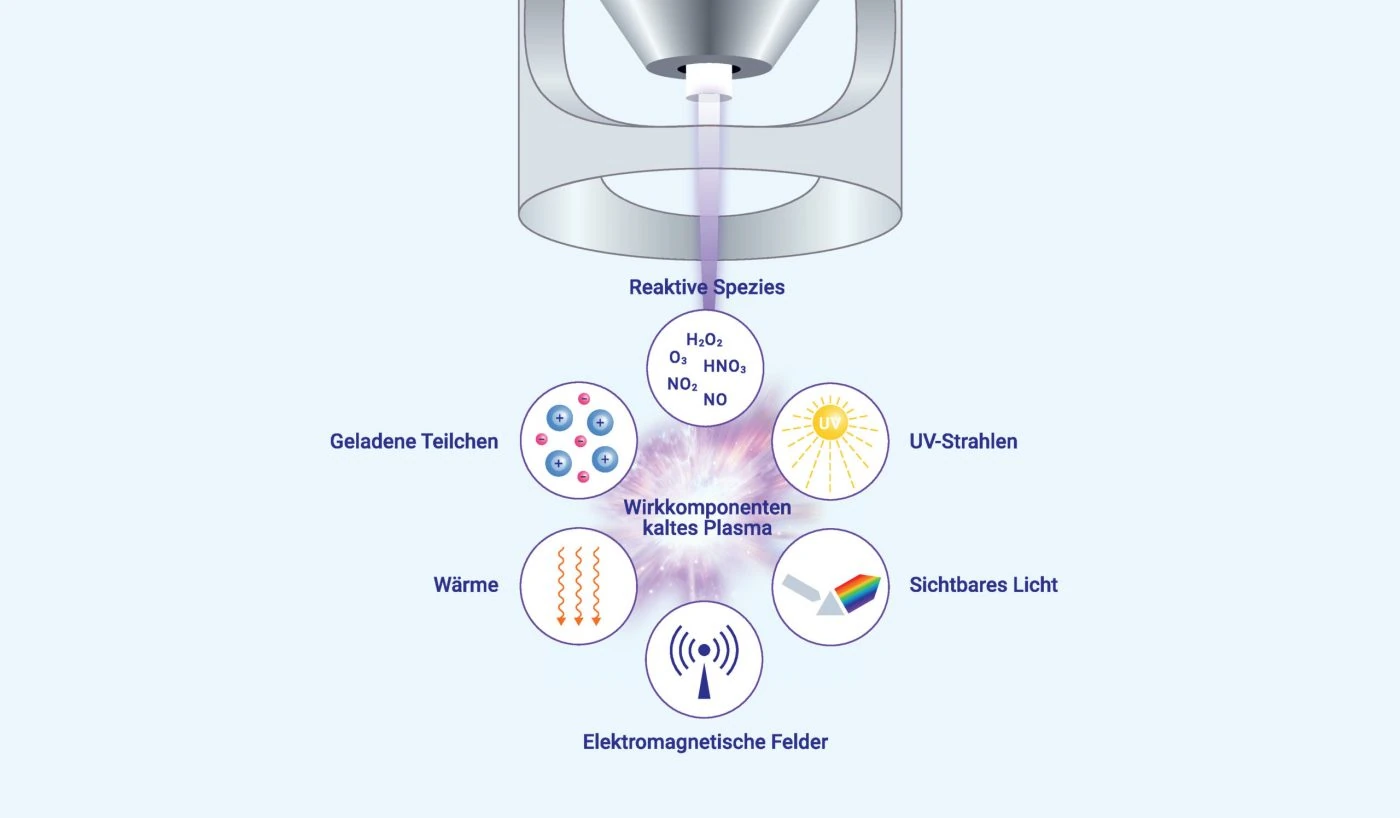
What distinguishes cold plasma from other physical methods is its whole bundle of active components. Together they have a powerful germ-killing effect and at the same time can trigger biological wound-healing processes.
The physical active components
- Reactive species (e.g. H₂O₂, O₃, NO, HNO₃)
- Free radicals, ions and electrons (charged particles)
- Electromagnetic fields
- Weak UV radiation & visible light
- Tissue-compatible heat (temperature at the tissue < 40 °C)
The biological effect
- Inactivation of a broad spectrum of pathogens, including multi-resistant germs such as MRSA
- Promotion of microcirculation — improved oxygen and nutrient supply to the tissue
- Stimulation of tissue regeneration (new cell formation) down to deep skin layers
When a treatment is useful
Cold plasma therapy can provide support for a range of wound and skin problems. Common areas of application are:
- Chronic and poorly healing wounds that do not settle over a longer period
- Chronic skin infections that respond only slowly to other measures
- Wounds with multi-resistant pathogens such as MRSA, where antibiotics reach their limits
- Burns and superficial skin injuries
- Wounds in hard-to-reach places such as skin folds or ears, where a dressing holds poorly
Whether cold plasma therapy is suitable for your animal depends on the type, location and cause of the wound. We make this assessment after an examination at the practice. Cold plasma is often used as one building block of a more comprehensive wound treatment, together with cleaning of the wound and, if necessary, further measures.
How a treatment at the practice works
At the start there is an examination of the wound. We assess how extensive it is, whether an infection is present and which treatment is sensible. Only then do we decide together with you whether cold plasma therapy is used.
For the application, the plasma source is brought close to the wound surface. The cold plasma thus reaches the affected tissue directly. A single treatment usually takes only a few minutes. Because the plasma is cold and does not hurt, most animals tolerate the session calmly — sedation or anaesthesia is usually not required. This also makes the treatment well tolerated for older or weakened animals.
How many sessions are needed cannot be stated in general terms. It depends on the type of wound and its course of healing. Several short treatments at a set interval are often useful. We observe how the wound responds and adapt the treatment plan. Between the sessions we discuss with you what you should pay attention to at home.
Advantages of cold plasma therapy
Within wound care, cold plasma therapy offers several advantages. It is painless, since the plasma is generated at room temperature and is not hot. Because the treatment is well tolerated by most animals, it usually does not require sedation. The procedure acts in a targeted way against bacteria, viruses and fungi on the wound surface, without damaging healthy tissue through heat.
A further point concerns the use of antibiotics. Because cold plasma reduces germs directly at the wound, it can complement antibiotic treatment and, in suitable cases, reduce the need for it. With wounds involving multi-resistant pathogens in particular, this is an important aspect. Whether and to what extent the use of antibiotics can be adjusted is, however, something we always decide in the individual case. We make the treatment decision on the basis of the examination.
The application can also be used on animals of all sizes, from the small pet through the cat to the large dog. Wounds in places where a dressing holds poorly can also be reached well.
What cold plasma can achieve — and what it cannot
As helpful as cold plasma therapy can be: it is one building block of wound treatment, not a substitute for a thorough veterinary assessment. A poorly healing wound often has a cause that must first be found and treated, such as an underlying illness, a foreign body or unfavourable strain on the wound.
This page therefore does not replace an examination at the practice. If your animal's wound does not heal, becomes inflamed or causes you concern, we first clarify the cause together and then decide which treatment, with or without cold plasma — is the right one.
Cold plasma therapy in Cremlingen and the region
Our practice in Cremlingen is easy to reach for pet owners from Braunschweig, Königslutter am Elm, Wolfenbüttel and Wolfsburg. If your animal has a wound that will not heal or shows a stubborn skin infection, we are glad to arrange an appointment. We will advise you personally and check whether cold plasma therapy is an option.